

eCommerce Search Didn't Get Better. It Split Into Three Channels.

Read summarized version with
For almost two decades, product discovery typically meant two jobs: rank high on Google SERP, and keep your store's search bar from embarrassing you. Both jobs were stable enough that you could hire someone to manage them, measure the impact from time to time, and make changes if necessary.
That model has completely changed in 2026, and most eCommerce brands haven't noticed because, on the face of it, nothing looks broken. Your rankings are fine. Your search bar still works. Sessions dip a bit, and you blame the ad account.
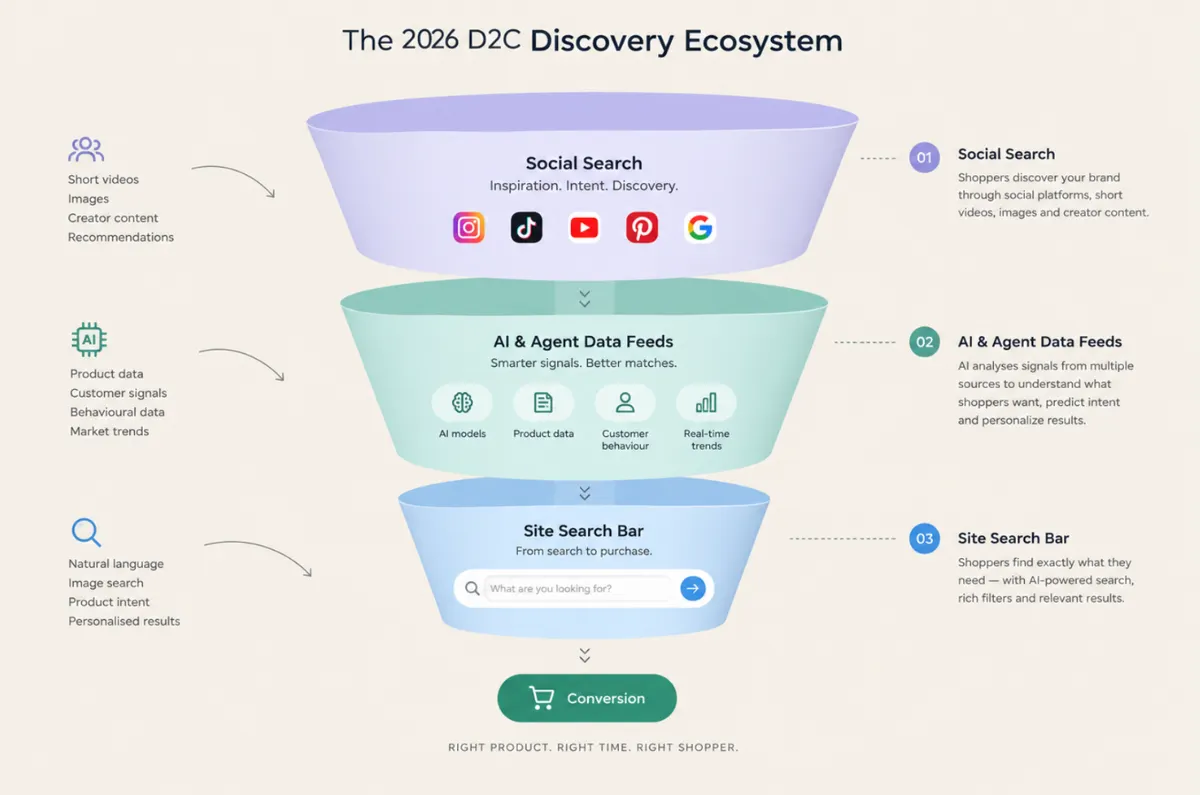
But here's what actually changed. Discovery now runs across three distinct channels/platform, each with its own job in your conversion funnel:
- Social Search: The acquisition magnet that pulls shoppers to your site.
- AI & Shopping Agents: The background data layer that evaluates options.
- Your Site's Search Bar: The conversion engine where transactions actually happen.
Fixing one channel does nothing for the rest. But if you get the hierarchy wrong, you waste your budget. Social content and AI feeds pull people to your online doorstep, but your store's search bar is where the money changes hands and enters your bank account.
Channel 1: The Search Bar Is Where Conversions Actually Happen
Let's eliminate the AI noise and look at the single most profitable piece of real estate on your storefront: your own search bar.
Social ads, TikTok clips, and AI mentions exist for one reason. They help you get a shopper onto your domain. But once they arrive, they don't browse your navigation menu like it's 2019. They head straight for your search box.
Across the D2C eCommerce landscape, visitors who use a site's internal search bar convert at nearly 2 to 6 times the rate of typical visitors browsing the same site. When you look at high-intent queries, that gap widens even further.
Constructor studied 609 million searches across 113 eCommerce sites and found that shoppers who use site search represent nearly 24% of total visitors, but they drive roughly 44% of total revenue and 45% of add-to-cart clicks. They buy at 2.5X the rate of everyone else on the platform.
Why is that so? Because social discovery creates the initial spark, but your site's search bar handles the actual purchase intent.
Imagine this: someone who arrives from an Instagram video showing a specific aesthetic doesn't want to scroll through 400 items in your catalogue. They will simply type "linen shirt navy" into your search bar. They aren't browsing anymore. They're actively looking for the same shirt they saw in your Instagram post, or in rare cases, something similar.
Now look at where most D2C stores burn their acquisition spend. While they focus on building an aesthetically pleasing social media page, they often forget to map the performance of their site's search bar. If a shopper types "lenen shirt nevy" (making a typo), the search bar returns a "No Results Found" message.
Sit with that operational failure for a second. You paid top dollar on Meta, TikTok, or influencer partnerships to pull that visitor to your site. They took the extra step of telling you precisely what they wanted in their own words. And your store responded with a blank screen. This is a classic example of potential revenue loss.
What To Fix Immediately:
Pull your internal zero-results report and sort it by search volume. You'll consistently see three prominent categories of missed revenue:
- Real Catalogue Gaps: Missing inventory or products you don't carry. This is a merchandizing and buying decision, and not a search configuration issue.
- Word Mismatches: A shopper arrived looking for "ripped jeans" because that's what a social creator called them, but your product page titles them "tapered jeans." That's a simple synonym rule, and fixing it takes just a couple of hours.
- Typos and Misspellings: Simple spelling errors that any competent eCommerce search tool should absorb automatically.
Your benchmark goal must be to bring down zero-result search pages under 5%. Anything above that is directly draining your return-on-ad-spend (ROAS).
Once you've fixed this issue, look at high-volume searches that return dozens of products but zero completed sales. These are particularly sneakier because your analytics dashboard looks healthy - good query volume, decent click-through rate, but conversions remain zero. That almost always means your relevance engine is showing the wrong products at the top of the search grid.

Semantic Search Isn't A Switch You Can Flip
Platforms like Shopify offer native semantic search, but the operational reality is far messier than the marketing announcements suggest.
Many D2C brands report that early iterations leaned heavily on image data rather than structured product attributes. As a result, search results looked visually identical on the screen, but they function completely differently in real life. Some online stores also saw relevance metrics drop immediately after rolling it out because the system guessed wrong about buyer intent. And on deeply integrated platforms, you can't always toggle it off to return to basic keyword matching.
Semantic search isn't a bad idea; it just requires active tuning. You can't simply install it and walk away.
Let's consider a real-world scenario. Halden Supply sells technical outdoor gear. It houses nearly 900 SKUs with heavy technical specifications. A shopper lands on their site and types "waterproof jacket for hiking in rain, breathable" in the search bar. A standard keyword search chokes because no single product's title contains that entire sentence. Semantic search understands the natural language request instantly.
At the same time, if Halden's backend product catalogue doesn't distinguish between "water-resistant" and "waterproof" in its attribute tags, semantic search will serve up incorrect jackets with complete algorithm confidence. The search engine understood the shopper's prompt perfectly. But the store's product data failed to deliver the right results.
The same pattern runs through the modern eCommerce stack today.
Better search algorithms don't magically fix bad product data problems; they simply expose it.
When Shoppers Can't Describe What They Want
Let's face it. Some high-intent searches will never work in a standard text box, no matter how advanced the language model becomes.
A shopper saw a T-shirt on someone at the airport. Another took a photo of a lamp they liked in a hotel room they stayed in. The third wants to buy the same necklace that her friend has but doesn't know the technical term for the chain weave.
Textual search fails in these moments, and it fails silently. The shopper types "gold necklace" and gets confronted with 520 generic product listings, only to realize that either she'll have to skim through all 520 pieces manually or won't find what she's looking for, and will eventually leave the site permanently.
This is where visual search comes in handy. It fixes this conversion friction by letting shoppers upload photos directly into the search bar to match catalogue items by sight. It earns its return on investment (ROI) in categories where human language is a weak descriptor:
- Apparel & Fashion: Specific patterns, cuts, draping, and subtle design flourishes.
- Jewelry & Accessories: Complex settings, weaves, clasps, and geometric shapes.
- Home & Living: Aesthetic choices where "that table" isn't a searchable term, and virtually nobody types "brass arc floor lamp with wooden base."
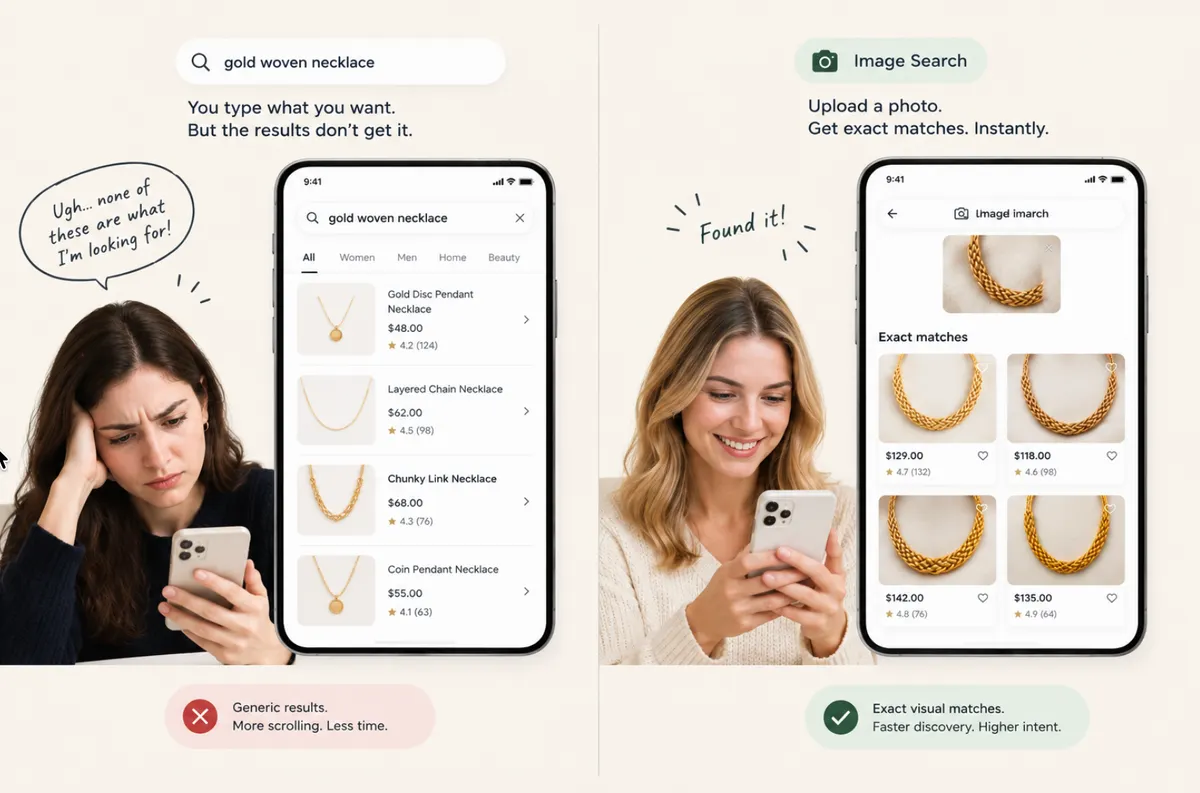
Here is the diagnostic test for your store. Look through your search analytics for queries that are broad, highly popular, and convert horribly. Those are rarely relevance algorithm failures. They are moments where the shopper lacked the exact words to describe what they were looking for, and no amount of keyword synonyms can bridge the gap.

Channel 2: Your Product Feed Is Now A Storefront
While your site search bar closes the deal on your domain, AI discovery engines help decide whether your products get recommended in the first place.
With the increasing use of AI, especially for seeking recommendations on things like which running shoes would suit flat feet under $120, or where to buy plus-size clothes in Spain, that assistant never renders your landing page or looks at your web design. It reads structured data including product feeds, schema markup, attributes, and API endpoints.
Google updated Merchant Center with conversational attributes specifically designed for Gemini and AI Mode. These extend far beyond the basic item titles, color swatches, and price points, and require rich structured data like:
- Q&A Pairs: Direct answers covering fit, sizing nuances, and specific use-case scenarios.
- Matching Accessories: Items designed to pair directly with the main SKU.
- Substitute Products: Recommended alternatives when an item goes out of stock.
Google has been blunt about what happens when these structured fields are left empty. The engine doesn't guess. It rather tags these attributes as unknown and redirects the shopper to a competitor whose product feed actually answered the prompt the shopper gave.
So, you don't lose that shopper because your physical product is inferior. You lose because your competitor's feed gave the AI engine the data it required to make a confident recommendation to the shopper.
What To Fix Immediately:
- Audit Feed Completeness By Category: Never rely on overall catalogue completeness scores. Many times, aggregate metrics hide huge product gaps because your top 20 bestsellers are well-documented while hundreds of long-tail SKUs sit practically invisible to the shoppers.
- Prioritize High-Intent Attributes: Focus on specific questions that buyers ask immediately before purchasing. These include fit and sizing for apparel, technical compatibility for consumer electronics, active ingredients and skin types for beauty, and dimensions and materials for home goods.
- Ensure Multi-Channel Consistency: Ensure your storefront data, raw feeds, and Merchant Center listings match one another. If your product page says one thing, your feed says another, and your Google listing says a completely different thing, AI agents will quickly catch this contradiction and bypass your brand rather than risk recommending inaccurate information.
Being Cited Isn't The Same As Being Buyable
Understanding the difference between being cited by AI and being buyable through AI is critical for eCommerce brands, especially today.
The market has easily muddied the word "agentic," using it to describe two completely different technological functions.
- External Shopping Agents: Independent software tools that act directly on behalf of the customer and may complete transactions without even loading your front-end store design.
- Internal Stack Agents: Autonomous tools integrated inside your online store's software stack that power on-site search, recommendations, and real-time personalization.
Both are real, but they solve completely different business challenges.
You can easily win one while losing the other. A brand can be recommended across dozens of AI chat answers while remaining technically impossible for an agent to purchase from. Conversely, a store can be fully integrated for automated checkout protocols while remaining entirely unmentioned in conversational AI search results.
The infrastructure behind agentic checkout developed at a rapid pace:
- Universal Commerce Protocol (UCP): Announced by Google to create open standards for agentic shopping.
- Instant Checkout: Launched through OpenAI and Stripe to enable direct purchasing inside conversational interfaces.
- Universal Cart: Demonstrated across Google properties to unify cart state across Gemini, Search, YouTube, and Gmail.
- Early Enterprise Adoption: Deployed by major retailers including Nike, Sephora, Target, Ulta, Walmart, and Wayfair, alongside leading D2C brands like Fenty Beauty and Steve Madden.
While direct agentic purchase volume remains a small portion of overall eCommerce transactions today, setting up clean data pipelines ensures your brand is indexed properly as these automated workflows scale in the coming days.
Channel 3: Social Pulls People In. Your Search Bar Closes The Deal
There's a common misunderstanding around social search. While platforms like TikTok, Instagram, Facebook, and YouTube now account for over 60% of top-of-funnel product discovery (compared to Google's 34.5% share of total search volume), social media is rarely where the final eCommerce transaction takes place.
Social media is your discovery engine, not your checkout counter.
Gen Z shoppers use social platforms to discover trends, evaluate aesthetic choices, and see products in action. But when they decide to evaluate a purchase seriously, they jump from the social app directly to the brand's website. Once they land on your site, they don't browse static collection pages. They use your search bar to find the exact item, check sizing, verify color options, and complete the purchase.

If your social marketing generates millions of impressions but your on-site search bar fails when those visitors land, your conversion rate falls. Social pulls traffic to your site. But it's your internal search bar that actually converts that traffic into revenue.
What to do:
- Align Social Terms with Search Synonyms: Ensure phrases, nickname terms, and trending product descriptions used in your social captions and video text are mapped as direct synonyms inside your store's search engine.
- Treat Video Text as Indexable Copy: Write social captions and on-screen text around high-intent search queries rather than abstract brand slogans.
- Optimize the Post-Click Landing Experience: Make sure that when a user clicks through from a social campaign, your site search bar is prominently displayed and ready to handle exact query matches.

Rebuild Measurement Before Your Dashboard Lies To You
Analytics dashboards across the industry are beginning to show declining session counts even as overall revenue and conversion health improve. Online store owners who fail to adapt their metrics risk making poor operational decisions.
More than 80% of total Google searches now end without an outbound click to an external site. For queries that trigger AI Overviews, that figure rises to roughly 83%, compared to 60% for legacy search layouts.
However, the referral traffic that does reach your store from AI-assisted search behaves fundamentally differently. Meanwhile, AI Overviews reduce total organic click volume by about 18%. The visitors who actually land on your store convert approximately 23% higher. You receive fewer total sessions, but the visitors arriving on your site possess significantly higher purchasing intent.
If your executive reporting still treats raw session volume as the primary performance metric, you will mistakenly cut marketing investment to the channels delivering your highest-margin customers.
Shift your analytics tracking to these core performance indicators:
- Revenue Per Search (RPS): The average dollar value generated every time a visitor uses your internal search bar.
- Search-Driven Revenue Percentage: The proportion of total store sales driven directly by shoppers who interacted with site search.
- Branded Search Lift: Increases in direct, high-intent searches for your specific brand and product names.
- Post-Mention Direct Traffic: Spikes in direct store visits immediately following product citations in AI recommendation engines.
The Ceiling Nobody Wants to Discuss
An e-commerce growth playbook that ignores consumer sentiment will fail over the long term.
Shopper trust in fully automated systems remains surprisingly fragile. Comprehensive consumer research conducted by HubSpot and SurveyMonkey across more than 15,000 shoppers revealed that only 30% of consumers trust AI-generated search results completely or even a lot. Additionally, 82% of shoppers still demand access to a real human customer service representative, even when automated support offers identical wait times and resolution outcomes.
Most critically for D2C brands: 28% of consumers report that they have actively stopped purchasing from a specific brand due to a poor, overly aggressive, or frustrating AI implementation.
Automation must serve the customer experience, not just cut operational costs. The brands that win will not be those that replace every human touchpoint with an automated bot, but those whose underlying technology operates quietly and accurately behind the scenes—especially when a shopper relies on their internal search bar to find what they need.
The Order of Operations
If you are allocating engineering time and budget for the upcoming quarters, execute these four priorities in sequence based on financial return:
- Optimize Your Site Search Bar (Week 1): Focus on your highest-converting asset first. Eliminate zero-result queries, configure synonym mappings, and fix typos. Because site searchers convert at nearly 40% higher rates, fixing this delivers the fastest payback without spending an extra dollar on traffic acquisition.
- Enrich Backend Product Data (Month 1): Update product attributes, Q&A pairs, and specs category-by-category. High-quality product data simultaneously powers your internal search bar, supplies AI recommendation engines, and prepares your catalog for agentic checkout protocols.
- Set Your Protocol Strategy (Quarter 1): Audit your product feeds and checkout API architecture for UCP and ACP readiness. Establish clear timeline reviews for platform-level protocol integrations.
- Update Key Performance Metrics: Transition internal performance reporting away from raw session counts toward Revenue Per Search (RPS) and Search-Driven Revenue before traffic fluctuations trigger unnecessary strategy shifts.
Search is no longer a simple ranking problem, it is a readability and conversion problem.
The D2C brands that grow are those that recognize how the customer journey flows: social discovery pulls visitors to the store, structured feeds ensure AI platforms recommend the brand, and a high-performing site search bar closes the sale.
Your internal search bar remains the one channel entirely within your control, and it is where high-intent visitors turn into paying customers. When an interested shopper lands on your store from a TikTok video or an AI search summary, their next action determines whether you make a sale. If they type a query into your search box, your store must deliver an accurate, relevant answer immediately.
That is the exact infrastructure Glood.AI was built to power. Instead of managing fragmented third-party tools for search, recommendations, and visual discovery, Glood unifies your storefront experience on a single behavioral data engine. It powers adaptive site search, personalized product recommendations, and visual image matching in real time, ensuring that when high-intent shoppers use your search bar, your store turns that intent into completed conversions.
Start by pulling your store's zero-results search report today. There is immediate, high-margin revenue waiting to be unlocked.

Sign Up For Our Free Weekly Newsletter
Get the latest e-commerce insights, tips, and strategies delivered straight to your inbox.

Astha Khandelwal
A marketing enthusiast who holds experience in creating informative content around the culture of experimentation and conversion rate optimization. She has a knack for learning and loves to explore new and innovative avenues of the industry.
You May Also Love to Read

SEO vs AI Search: How eCommerce Brands Can Get Cited & Chosen
SEO gets you ranked. AI search gets you recommended. Learn how eCommerce brands can optimize for ChatGPT, Google AI, Perplexity, and drive more conversions.
Sep 14, 2026
Shopify Shares The New Normal for eCommerce Search
AI is changing how shoppers search. Discover what the shift means for Shopify brands and how intelligent search can improve product discovery and conversions
Sep 10, 2026