

Returns in 2026: What Global Brands Learned the Hard Way & Why It's an Inventory Problem

Read summarized version with
Almost 70% of the world's brands treat eCommerce returns as a logistics cost. Ship it back, refund it, absorb the cost, and move on. That framing survived half a decade because the escape hatches were always open. If the item came back damaged, you wrote it off. If the policy got expensive, you added it to the fee. If the numbers looked bad, you buried them in shipping.
Come 2026, those hatches are now closing. A regulator in India made write-offs illegal for a large category of Google. Generative AI made photo evidence worthless, and AI shopping agents started reading return policies as structured data before deciding whether to show your products to end consumers at all.
What has emerged from these pressures is a different diagnosis: Returns are not primarily a logistics problem or a customer experience problem. They’re rather an inventory and forecasting issue. The brands that figured that out first are the ones whose margins survived and remained intact.
In this blog, we’re not discussing what is return or define what is return to origin. Instead, we’ll break down five recent events that taught eCommerce brands lessons for life, what exactly changed, and where the forecasting argument leads today.
Let’s dig in.
Event 1: The AI-generated Damage Claim (February–March 2026)
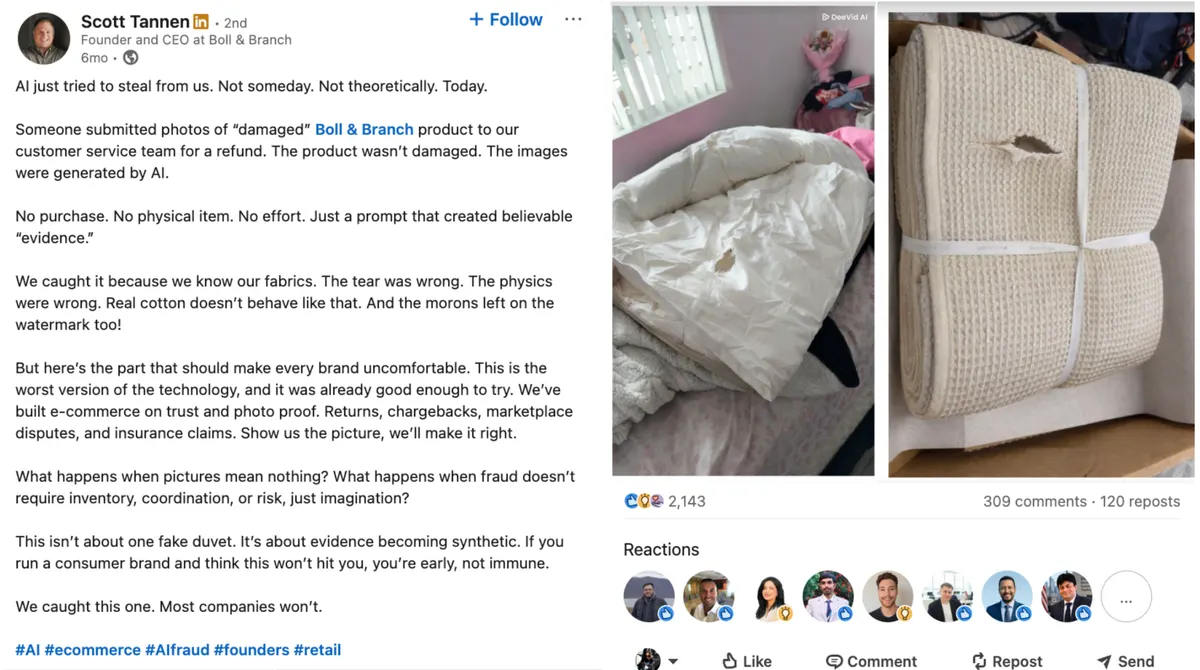
Scott Tannen, CEO of Boll & Branch, a bedding brand, was working through a customer service ticket one day. A shopper claimed a set of sheets had arrived torn, with multiple photos attached.
The tear was unusual and wrong. Cotton doesn’t fray that way. One image carried an AI watermark as well. His team pulled recently raised customer issue tickers and found several more damaged photos that appeared AI-generated.
Tannen posted about it on LinkedIn in early 2026 and received more than 2000 reactions, 309 comments, and 120 reports. The engagement told him the pattern was not isolated and he wasn’t alone in this mess. Within weeks, Modern Retail, PYMNTS, Chief Marketer, and eMarketer had documented the same behavior at multiple brands, including tote maker Bogg Bag. The reported variants extended beyond fake damage AI-generated photos to fabricated carrier drop-off receipts and even forged police reports claiming theft.
What The Brands Changed
Neither brand solved this issue by purchasing new software. Instead, they adapted their operations.
- Bogg Bag - They standardized their language. When images look manipulated or a request seems outside warranty terms, agents now use pre-approved wording rather than improvising. Because their bags are bulky and expensive to ship, they kept returnless refund only for genuinely defective goods, but mandated physical return inspections when a defect claim looked suspicious.
- Boll & Branch - They shifted the evaluation unit from the claim to the claimant. The company began weighing purchase and return history at decision time, such as first-time buyer, no proof of purchase, or pattern of repeat returns. They reserved the right to require the item back for warehouse inspection before processing the refund or sending a replacement.
The Lesson
- Photographic proof is no longer acceptable unless customers take pictures in real-time.
- If your returns flow auto-approves refunds on an image upload, that is now a system exploit.
- The two-tier fix:
- Trust the history of the shopper by default, reserve physical inspection for the suspicious tail,
- Write your refusal language before an agent has to invent it under pressure.
Event 2: Casper, Allbirds, And The Cost Of Generous Policy Nobody Priced
Casper Sleep built its mattress brand on a 100-night risk-free trial. While it worked as a marketing wonder, it did not work as economics for the company. That policy is estimated to have eroded brand margins by up to 40%, and the company was losing roughly 20 cents on every dollar of revenue around its 2020 IPO. Casper was later taken private in 2022 and acquired by Carpenter Co. in October 2024.
Allbirds followed a similar trajectory. While the brand’s revenue surged to $297.8 million in 2022, it plunged by 35% to $189.8 million by 2024. After its stock dropped almost 95% from its 2021 listing, drawing a Nasdaq delisting warning, Allbirds abandoned its D2C-only stance and expanded into wholesale channels like Amazon, REI, Nordstrom, and Dick's Sporting Goods.
The Market Takeaway
Return policy is a product cost and not a marketing lever. A generous window is a real liability with a real unit cost. If it’s not priced into the product cost from the very beginning, it’s being funded by your brand’s margins that never actually existed.
The Lesson For You
Don’t simply "tighten your policy." Instead, know what your policy costs per unit before you advertise it. Calculate your fully loaded cost per returned order, which includes:
- Return shipping
- Inspection labor
- Repackaging
- Resale-value loss
- The original customer acquisition cost (CAC)
Then, check whether your gross margin actually covers it at your current return rate. Most brands never run this calculation on a single SKU.
Event 3: The Return-fee Wave (And Why Blanket Fees Backfired)
Between 2022 and 2024, retailers moved fast on fees. Brands like Zara and J.Crew added return charges to every order. According to Happy Returns' annual study published in 2023, 81% of retailers had started charging for at least one return method within the prior 12 months.
But the results were messy.
- Roughly 40% of retailers saw a decline in sales.
- A similar share saw customer complaints increase.
- 33% lost customers outright
- 55% of shoppers abandoned their purchase because the return options felt very restrictive.
Why Blanket Fees Backfired?
Treating all customers who return items under one homogenous umbrella destroyed top-line revenue. Blanket fees create friction at the point of intent, hampering loyalty and high-value customers while doing little to stop systemic return fraud. Chasing honest customers for an occasional return penalizes them for shopping with your brand.
The Lesson
Don’t penalize the initial purchase decision across your entire audience. Blanket friction harms conversion rates faster than return costs erase business margins. Instead, brands must segment their shopper base, isolate the abusive return patterns, and apply policy friction selectively.
Event 4: The EU Closes The Write-Off (19 July 2026)
Under the Ecodesign for Sustainable Products Regulation, starting July 19, 2026, large companies in Europe (which have 250+ employees, €50 million turnover, or €25 million in assets) are prohibited from destroying any unsold clothing, clothing accessories, or footwear. Medium-sized companies will face the rule by 2030.
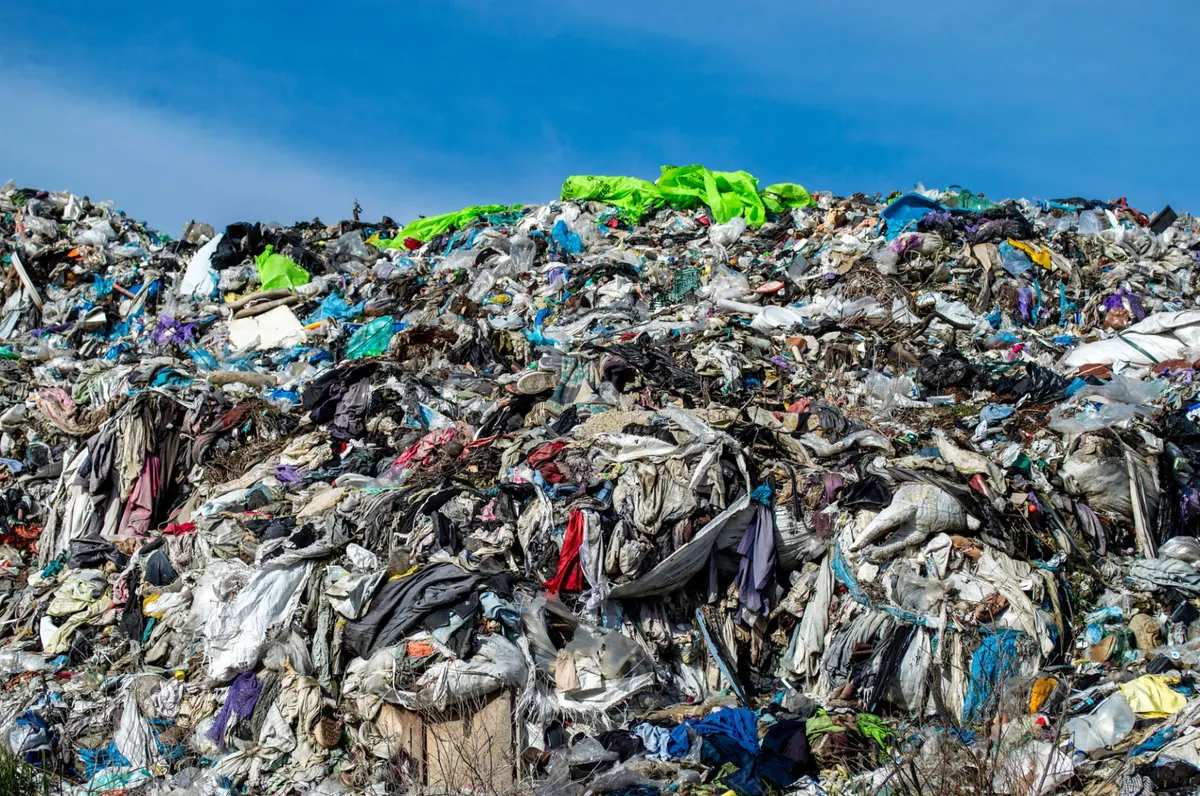
The European Environment Agency estimates that 4% to 9% of textile products placed on the EU market are destroyed before they’re ever used - up to 594,000 tonnes annually. In Germany alone, close to 20 million returned items are discarded yearly. The European Commission's mandate is clear: brands must explore resale options, remanufacturing techniques, donation, or reuse their products.
What Changed Operationally?
Companies now have no option but to document every returned unit meticulously:
- Where it is located.
- What condition it is in.
- Whether it can be resold, repaired, donated, or recycled.
- Evidence of final disposal.
That evidence lives in the handoffs between your returns flow, warehouse, and inventory system, and not just in a PDF sustainability document.
The Lesson
A returned item is no longer a write-off line in the P&L. It’s an inventory record with a state, a condition grade, and an audit trail. Even if you do not sell into the EU, adopting this discipline recovers capital you are currently throwing away in quarantine bins.
Event 5: Myntra’s “Return-as-a-Service” and The Case Against Copying It
(Note: While frequently cited as a current 2026 initiative, Myntra's experiment actually ran in September 2023. However, the underlying substance remains highly relevant even today.)
In a one-off stance, Myntra applied a flat convenience fee of ₹199 to ₹299 on orders from customers with high return rates, which amounted to roughly 2% to 5% of its 50 million active users. However, the company quickly concluded that a flat, per-order charge risked damaging customer behavior beyond just that cohort. They subsequently pivoted to a much smaller fee of ₹15 to ₹30 per return, and applied it only after a customer exhausted a set number of free returns.
The Derived Lesson: Price The Return, Not The Order
A flat charge on an order punishes the purchase decision. It’s the exact action you spent customer acquisition cost (CAC) to produce. A small charge per return (after a free allowance) prices the behavior you actually want to change, leaving the initial purchase friction-free.
The Counter-Evidence For "Returnless Refunds"
If you charge the abusive tail, what do you do with your loyal customers? Peer-reviewed research published in the February 2026 issue of the Journal of Marketing Research (Costello and Bechler) offers a compelling answer.
The nine-study paper found that customers told to keep an item they wanted to return (a returnless refund) were subsequently more likely to buy from the brand again and recommend it, compared to both customers who went through a standard return and those who never returned anything at all. This mechanism generates perceived "brand warmth."
The study noted the effect is strongest when:
- You do not demand proof of a product defect.
- The decision is framed as specific to that customer, not a blanket policy.
- You provide a customer-centric or environmental reason (e.g., suggesting they donate the item).
The Verdict
These two findings sit together perfectly: charge the narrow tail that abuses the policy, and give margin away generously to the customers who do not.
The Core Argument: Returns Are An Inventory Data Problem
Analyze what these five events actually demand:
- Claimant history at decision time.
- Per-unit cost tracking of returned orders.
- Customer segmentation by return behavior.
- Condition state and disposition trails for every item.
- Targeted policies over blanket fees.
None of these are logistical capabilities. They’re inventory data capabilities.
Returns don’t just corrupt your demand forecast. But bad forecasting creates more returns.
The “Gross Vs. Net” Mechanic
Most product replenishment decisions run on gross sales. If a SKU sells 1,000 units in a month, your stock position drops, replenishment triggers, and you reorder.
But if that SKU returns at 35% (normal for apparel), real demand was only 650 units. Because your forecast read 1,000, you just ordered more of the exact product your customers reject most, funded by working capital that could have been spent on a SKU that actually sells through. Run that loop for three seasons, and you’ll have a warehouse full of the wrong inventory and a P&L that makes no sense.
Net-of-returns demand is the only real demand signal.
Three Inventory Failures That Compound The Problem
- Returned Units Sit in an Undefined State: A return moves through transit, receipt, grading, and disposition. Sellback stock must only increment at the final step. Incrementing earlier risks overselling ungradeable inventory; never incrementing creates dead capital your forecast can't see.
- Restock Latency is a Markdown Clock: In fashion, a returned garment takes ~three weeks to become sellable again, often missing its trend window. The delay costs you the margin difference between full price and clearance.
- Stockouts Cause Returns: When the right size or shade is unavailable, shoppers buy an adjacent, substitute option. That substitute carries a massive return probability. Those returns then hamper the forecast that failed to prevent the stockout in the first place.
The Loop: Bad forecasting causes stockouts -> stockouts cause substitution returns -> substitute returns corrupt the forecast.
Where To Intervene
To break this cycle and protect your margins, operations need to change at the foundational data level:
- Calculate demand based on net-of-returns per SKU, not blended category averages. The SKU with 40% returns and the SKU with 6% returns should not trigger the same replenishment logic.
- Define inventory states explicitly. Track items as returned, in transit, received, graded, restocked, refurbished, resale, or donated. Keep the trail (ESPR requires it, and it's good business).
- Treat stockout prevention as a returns program. Reduce forced substitutes to lower returns organically.
- Instrument the return reason at the SKU level. Size, fit, color, damage, late delivery - review this weekly. It’s the cheapest product feedback you will ever get.
- Tier customers before you tier policy. Look at history at claim time, be generous by default, and reserve physical inspection for the suspicious tail.
How Glood.AI Solves The Net-of-Returns Equation
Your return rate is not a fixed cost of selling online. It is a readout on how well your demand forecast, your stock position, and your product discovery agree with one another.
If you want those three talking, you need systems designed for modern commerce realities.
Glood.AI’s Inventory Planner (available on the Shopify App Store) is built to intervene precisely where the standard gross-sales loop fails. It swiftly predicts true demand and automates replenishment to prevent the stockouts that cause substitution returns in the first place.
By pairing the Inventory Planner with Glood.AI’s recommendation and search agents, you ensure the right product gets in front of the right shopper before they settle for a substitute. Together, these tools reduce wrong purchases, position stock exactly according to customer needs, and dramatically lower the operational load on your return management team.
Sign Up For Our Free Weekly Newsletter
Get the latest e-commerce insights, tips, and strategies delivered straight to your inbox.

Astha Khandelwal
A marketing enthusiast who holds experience in creating informative content around the culture of experimentation and conversion rate optimization. She has a knack for learning and loves to explore new and innovative avenues of the industry.
You May Also Love to Read