


AI Is Now the Storefront. Your Website Is the Warehouse.

Read summarized version with
Traffic from AI sources to retail sites grew 4,700% year over year. The infrastructure is live, the protocols are shipped, and early-mover compounding has already started. Here is exactly what has changed and what to do about it.
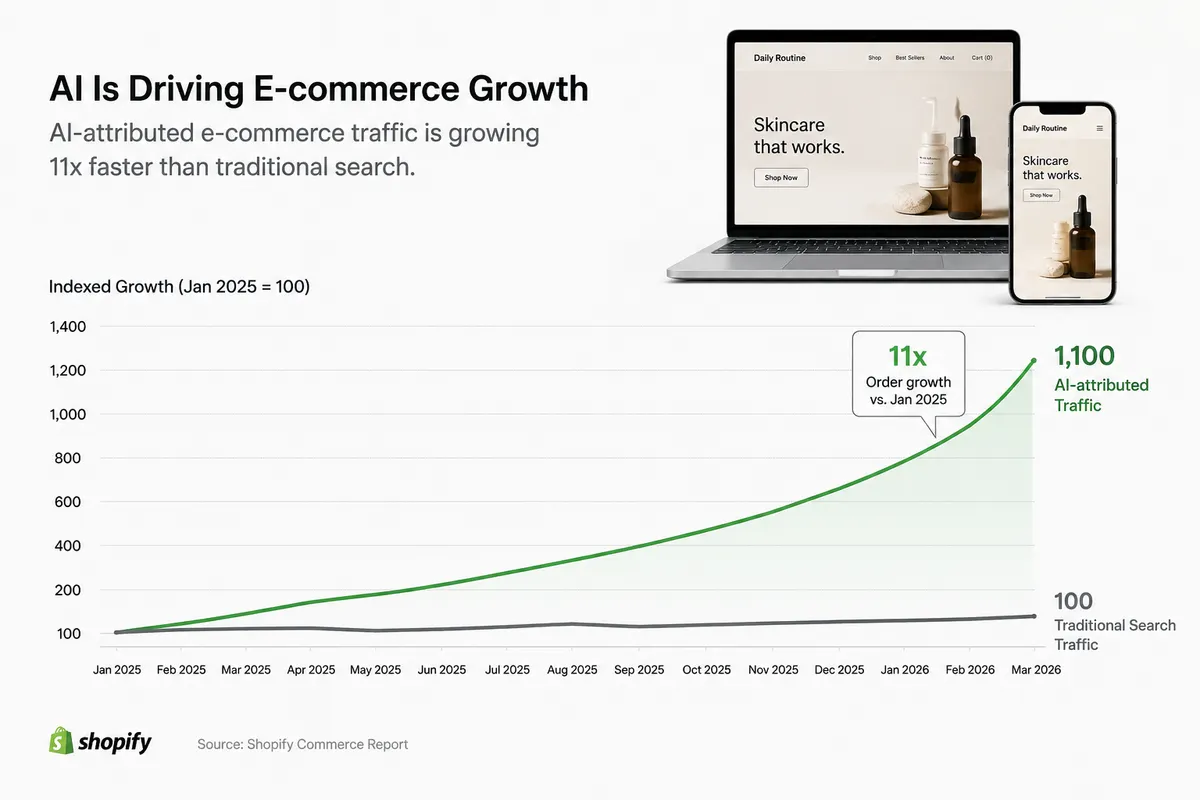
The 4,700% figure does not need a dramatic setup. If you follow commerce infrastructure on any level — whether through Shopify newsroom drops, Google I/O coverage, or the tech Twitter conversations that broke these announcements before any press release did — you already know something significant has shifted in how products get discovered and purchased.
What most brands are still working out is what it means for their specific stack, their catalog, and their investment priorities in the next 12 months. That is the question this piece addresses directly.

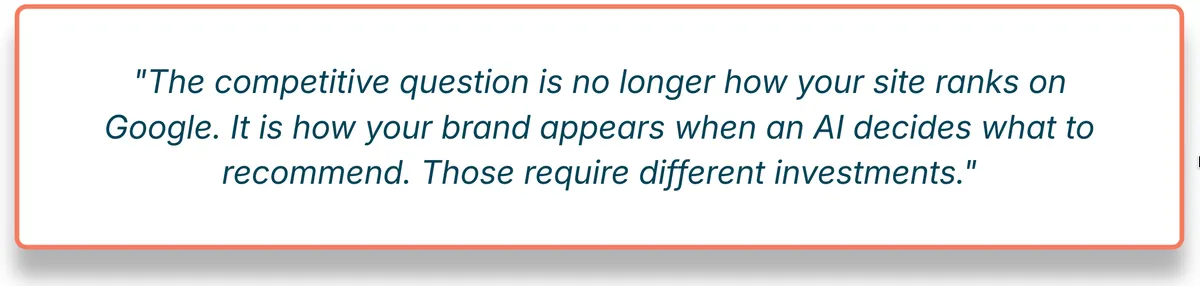
The Commerce Surface Has Moved. The Channel Is Not the Story.
The conversation tends to frame this as a traffic source problem: Google referrals are down, AI referrals are up, adjust accordingly. That framing undersells the structural change happening underneath.
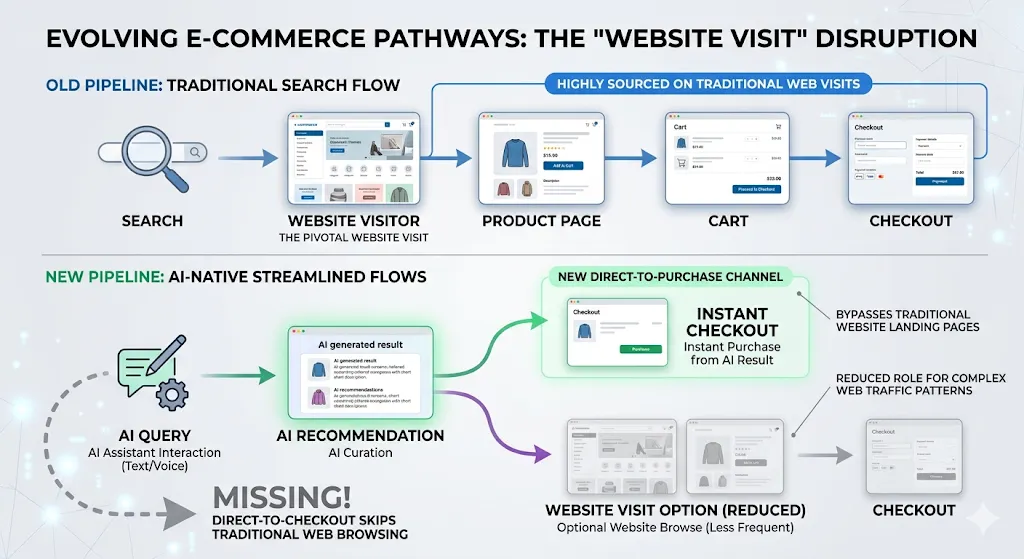
The acquisition channel is not what shifted. The surface where commerce actually happens is what shifted. For 15 years, the ecommerce model was a pipeline. A paid or organic listing brought a shopper to a product page. The product page did the work of converting intent into a cart. The cart was converted into a checkout. Every optimization investment targeted something inside that pipeline, and the website was the arena where all of it played out.
That pipeline is being interrupted at the first stage. When a shopper asks ChatGPT, "best moisturizer for oily skin under ₹800, fragrance-free," that is not a search query being routed through a different channel. That is a purchase intent signal being processed by a system that understands the full sentence, accesses available inventory across its catalog, and returns three product recommendations alongside a buy button. In some deployments, the checkout closes without the shopper ever navigating to a brand's website.
This is not one company experimenting. Amazon's AI assistant Rufus saw 33% of Prime members actively use it on Prime Day 2025. Walmart has Sparky. Target ran a full ChatGPT checkout integration in 2025. The coordination across players of that scale signals a permanent infrastructure shift, not a product cycle.
One honest caveat: this is not uniform across product categories yet. High-consideration purchases, where shoppers want to zoom into fabric texture or compare physical dimensions, still rely on the website to close. But even in those categories, the discovery layer has moved. The first touchpoint is increasingly an AI recommendation. The website converts it. The storefront function and the conversion function have separated.
What Agentic Commerce Actually Describes
"Agentic commerce" is the term being used across investor memos, product announcements, and NRF keynotes. It is worth a precise definition rather than treating it as a vibe word.
Agentic commerce refers to AI systems that complete shopping tasks on behalf of a user without that user manually navigating between sites. The shopper describes what they want in natural language. The AI interprets the intent, accesses a product catalog, applies filters (price range, brand preference, availability), and either surfaces a recommendation or completes the transaction entirely. The shopper does not browse. The AI browses on their behalf.
McKinsey's taxonomy identifies three operating models. The first is agent-to-site: an AI browses a merchant's storefront on a shopper's behalf and surfaces relevant products. The second is agent-to-agent: the buyer's AI communicates directly with the seller's AI to negotiate and transact, with no human navigating any interface. The third is brokered models: a neutral platform handles routing between buyer agents and seller catalogs. ChatGPT Instant Checkout and Google AI Mode currently operate on the brokered model.
Agent-to-agent is in early deployment. The gap between "early deployment" and "widely used" is compressing faster than most planning timelines assume. Two years ago, "agent-to-site" was the same kind of early-deployment concept. Today it is where 4,700% YoY traffic growth is happening.
The implication for brand strategy is this: in agentic commerce, the AI selects the recommendation. There is no second page of results to fall back on. There is no paid listing that rescues a brand with weak organic visibility. The shopper asks a question. The AI returns one to three products. Brands outside that answer set do not exist to that shopper at that moment.
ACP and UCP: The Two Protocols Running This Infrastructure
Two interoperability standards are now the technical backbone of AI commerce. Understanding what each one covers and who controls it is not optional context. These protocols determine whether your products are discoverable in AI shopping environments or not.
Protocol 1: OpenAI's Agentic Commerce Protocol (ACP)
Launched September 2025. Powers ChatGPT Instant Checkout. Payment processing runs through Stripe. Shopify merchants access it via Agentic Storefronts, enabled directly in the Shopify admin panel. Etsy sellers were enrolled automatically at launch, whether or not they had opted in intentionally.
Scope: Primarily covers the checkout and payment transaction step.
- Access via: Shopify Agentic Storefronts (for Shopify merchants)
- Access via: Shopify Agentic Plan (for non-Shopify merchants, no stack migration required)
- Catalog syncs to: ChatGPT, Microsoft Copilot
Protocol 2: Google's Universal Commerce Protocol (UCP)
Announced at the National Retail Federation conference in January 2026 by Sundar Pichai directly, which signals how seriously Google is treating this as infrastructure, not a product feature. Shopify co-developed the standard. Launch partners include Walmart, Target, Etsy, and Wayfair. Visa, Mastercard, Stripe, and American Express endorsed it at the announcement. BigCommerce joined in April 2026.
Scope: Full commerce lifecycle, including discovery, checkout, fulfillment, and returns. This is meaningfully broader than ACP.
- Access via: Google Merchant Center
- Catalog syncs to: Google AI Mode, Gemini
Most brands will need both protocols eventually. ACP covers the OpenAI ecosystem. UCP covers Google's. If you are a Shopify merchant, enabling Agentic Storefronts handles ACP access in one step and syncs your catalog to ChatGPT, Copilot, Google AI Mode, and Gemini without additional integration work. That is the highest-leverage action available to most Shopify stores right now, and it does not require new engineering resources.
Your Website's New Role: Infrastructure, Not Acquisition
The website is not disappearing. The role it plays has been restructured. Understanding that distinction clearly is what separates brands that invest intelligently from those that misread the moment in either direction, either dismissing the shift entirely or overcorrecting toward eliminating their web presence.
Brooks Running's VP of North America stated the new priority plainly in 2025: the focus is on making their site readable and understandable by AI systems. Structured data, accurate product attributes, complete descriptions, and review volume. Not homepage design. Not homepage animation.
Before the protocols, a brand's website served two functions simultaneously. It was the product warehouse, where inventory, specs, and catalog data lived, and it was the storefront, where customers actually browsed and purchased. Those functions are separate. The warehouse function stays on the website. The storefront function is moving into AI conversations.
The investment implication is direct. A product page that is visually refined but has thin descriptions, incomplete attribute fields, and no reviews will not surface in AI recommendation outputs, regardless of how well it converts when a shopper does land on it. A product with accurate technical specs, use-case-specific copy, and several hundred verified reviews will surface. AI recommendation ranking rewards catalog quality. It does not reward design budget.
Review volume, in particular, is systematically underweighted in most brands' roadmaps. It is one of the three most controllable inputs into AI recommendation systems. Price range and product category are largely fixed. Catalog data quality and review volume are variables you own. If your brand lacks a structured review generation process, building one ranks higher on the priority list than most other line items currently in your roadmap.
Sign Up For Our Free Weekly Newsletter
Get the latest e-commerce insights, tips, and strategies delivered straight to your inbox.

Astha Khandelwal
A marketing enthusiast who holds experience in creating informative content around the culture of experimentation and conversion rate optimization. She has a knack for learning and loves to explore new and innovative avenues of the industry.
You May Also Love to Read

From “Customers Also Bought” to Intent-Led Commerce: The 2027 Shift
Imagine every Shopify store as a vast, magical library. The librarian, our traditional recommendation engine, had to sift through enormous spreadsheets of numbers to figure out what a shopper might want next. Had they bought a blue shirt? Which products had they clicked on? What did other shoppers with similar histories buy? The system relied on patterns in past behaviour to make its next best guess. Making these predictions required complex mathematical models and multiple systems working toge
Oct 12, 2026
Beyond the Discount: How E-commerce Brands Can Maximise BFCM Orders
BFCM is the time when shoppers are already in a buying mindset.Brands can use this opportunity to make the shopping experience more relevant and valuable. During BFCM 2025, Shopify merchants generated $14.6 billion in global sales, up 27% from the previous year. More than 81 million customers purchased from Shopify-powered brands, while the average cart price stood at $114.70. For e-commerce brands, this creates a valuable window of high purchase intent.The question is what happens after shopp
Oct 12, 2026
The Ultimate BFCM Readiness Checklist You Need
Black Friday and Cyber Monday can turn a regular weekend into one of the busiest periods of the year for ecommerce brands. In 2025, Shopify merchants generated $14.6 billion in sales during BFCM, a 27% increase from the previous year. More than 94,900 merchants also recorded their highest-selling day ever on Shopify. For a D2C brand, these numbers come with a less glamorous reality: when demand rises sharply, small gaps in your store can become very expensive problems. A slow product page, an
Oct 9, 2026