From “Customers Also Bought” to Intent-Led Commerce: The 2027 Shift
Read summarized version with
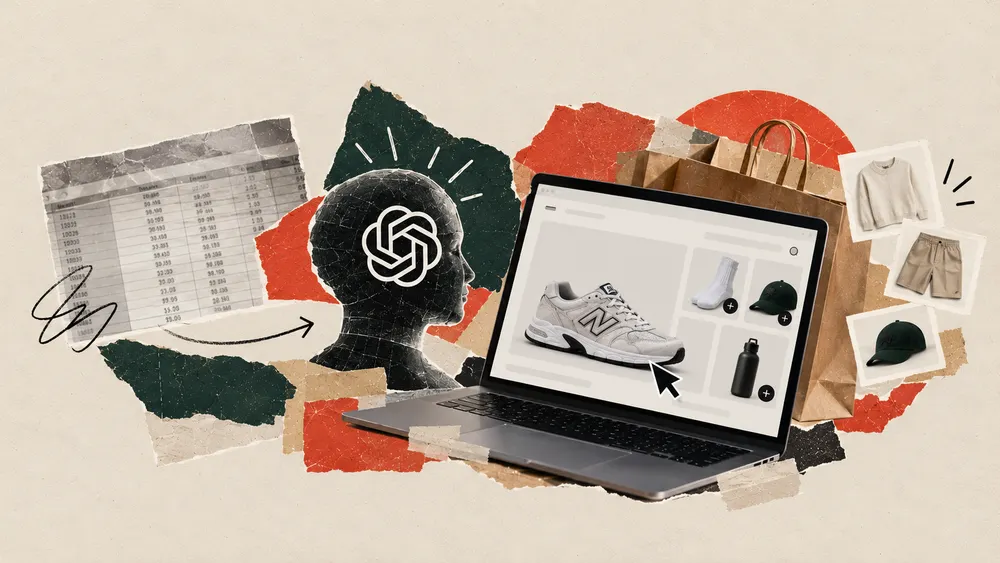
Imagine every Shopify store as a vast, magical library. The librarian, our traditional recommendation engine, had to sift through enormous spreadsheets of numbers to figure out what a shopper might want next. Had they bought a blue shirt? Which products had they clicked on? What did other shoppers with similar histories buy? The system relied on patterns in past behaviour to make its next best guess.
Making these predictions required complex mathematical models and multiple systems working together. While effective, traditional recommendation engines became increasingly complex and expensive to maintain, especially when experimenting with new features or adapting to new audiences. Meanwhile, Large Language Models (LLMs) were opening up a different approach to recommendations. With their broad world knowledge and strong understanding of language, they could interpret product information and shopper histories as text, recognise relationships between products, and use richer context to inform recommendations.
Think of it as giving our librarian an enhanced ability: instead of just scanning a shopper’s borrowing history, they could understand the story behind it. A shopper browsing lightweight shirts and linen trousers might be preparing for a summer holiday, for instance. But there was a catch. Off-the-shelf LLMs weren't ready to power production-grade recommendation systems on their own. They could hallucinate, recommend too many products, overlook critical context, or fail to account for the realities of ecommerce.
The opportunity, then, wasn't simply to plug an LLM into a Shopify store. It was to build a recommendation engine that combined the language understanding of LLMs with the specific data, constraints, and business objectives of e-commerce. That’s the thinking behind Glood's shift to an LLM-backed recommendation ranker: a foundation model post-trained on Shopify-specific data and objectives to rank products more intelligently, with shopper context and merchant goals in mind.
| Feature | Old Recommendation Engine (Spreadsheets) | LLM-Native Engine (Glood's AI Brain) |
|---|---|---|
| Data Format | Spreadsheets of sparse ID numbers and clicks. | Natural language stories (Context Engineering). |
| New Products | Takes weeks to gather enough data to recommend. | Instantly understands text descriptions of new items. |
| Understanding | Thinks "User clicked Item 402 and Item 811." | Thinks "User is buying lightweight summer vacation gear." |
| Upkeep | Requires heavy, expensive engineering updates. | Scales naturally as the AI model gets smarter. |
So how we recommend now using LLMs - Instead of looking at code numbers Glood translates your watch-history into short little story paragraphs like
“This user bought blue t-shirt, loved it, skipped the pants ”
They fit this story into a strict "token budget" (like a notebook page limit) so it doesn't get too long or expensive.
Teaching the AI: From General Knowledge to Store Expert You can’t just plug ChatGPT into a Shopify store and expect it to know how to sell. Off-the-shelf models are great at chatting, but they don't understand the nuances of conversion rates, inventory, or cart abandonment. To fix this, we train our engine in two phases:
- Phase 1: The Retail Expert (Foundation Model): First, we adapt a foundational model so it understands general e-commerce. It learns what a "summer sale" is, how "cotton blends" relate to "breathability," and how shoppers typically behave across different seasons.
- Phase 2: The Store Matchmaker (Post-Training): Next, we train it specifically on the goal of ranking products. We feed it millions of those "short story paragraphs" (our token-budgeted user histories). The AI learns that if a user buys a blue t-shirt and skips the pants, the next best item to show them is a matching blue cap, not a winter jacket.
Smart Business Rules over Simple Clicks: An off-the-shelf AI might just recommend low-cost products since they gather frequent clicks. However, Shopify merchants focus on overall store value, average order value (AOV), and moving designated stock.
Rather than building complex traditional logic to force these outcomes, we implement a Reward-Weighted Strategy. During model evaluation, our system assigns a higher rank score whenever suggested items drive:
- Higher profit margins per transaction.
- Catalog entries with active inventory.
- Products driving long-term buyer engagement.
Consequently, the engine optimizes directly for real merchant targets instead of chasing superficial user traffic.
The Need for Speed
(How it runs in milliseconds)
Serving at Shopify Speed (Prefill-Only Mode) Standard AI chat tools take time generating text character by character. When operating online stores, taking several seconds to surface item suggestions drives shoppers away instantly.
How does our recommendation framework deliver instant model evaluation within milliseconds? We rely on Prefill-Only Inference. Rather than prompting the system to generate narrative text, it simply processes the entire shopper background in one pass. It immediately feeds those vector signals into a catalog-aware scoring head, assigning a numeric rank across every catalog entry at lightning velocity to serve top choices onto the screen. No stream output, no lag, just immediate prediction accuracy.

The Evolution: How Amazon and Netflix Paved the Way
The Amazon era (“Who bought what” method) -
Back in the late 90s and early 2000s, Amazon invented something called Item-to-Item Collaborative Filtering. In our magical library analogy, this is like the librarian noticing, "Hey, almost everyone who checks out the Batman comic also checks out Superman." So, they started automatically recommending Superman to Batman readers. It was revolutionary, but it had a massive flaw: The Cold Start Problem. If a brand new book arrived at the library, the librarian had no idea who to recommend it to because nobody had checked it out yet. It relied purely on past overlapping behavior, not on actually understanding the book.
The Netflix Era (The "Heavy Spreadsheet" Method):
In the following period, Netflix advanced this approach by employing Deep Learning and Feature Engineering. Moving beyond basic behavioral co-occurrence, they constructed vast, intricate data tables with thousands of granular attributes. Systems monitored streaming times, device types, affinity for specific genres, and director preferences. Although highly effective, maintaining this framework proved overwhelmingly tedious. Whenever introducing new catalog formats like live events or gaming, technical teams spent months redesigning mathematical formulas and manually engineering new tabular features. While robust, the setup remained fragile and required massive engineering overhead to scale.
The LLM-Native Revolution (2025–2026 Transition): Now, we enter the current paradigm. Netflix recently released landmark studies around GenRec, demonstrating that relying on extensive tabular feature sets can be replaced by supplying a foundational AI model with a rich narrative context. Possessing broad world knowledge out of the box, the LLM inherently grasps that a viewer enjoying lighthearted dramas would likely appreciate romantic comedies, bypassing the requirement for custom engineering equations.
Glood brings that understanding to every Shopify store, so shoppers find what they came for in milliseconds, and sometimes something they didn’t know they wanted.
Sign Up For Our Free Weekly Newsletter
Get the latest e-commerce insights, tips, and strategies delivered straight to your inbox.
You May Also Love to Read

Beyond the Discount: How E-commerce Brands Can Maximise BFCM Orders
BFCM is the time when shoppers are already in a buying mindset.Brands can use this opportunity to make the shopping experience more relevant and valuable. During BFCM 2025, Shopify merchants generated $14.6 billion in global sales, up 27% from the previous year. More than 81 million customers purchased from Shopify-powered brands, while the average cart price stood at $114.70. For e-commerce brands, this creates a valuable window of high purchase intent.The question is what happens after shopp
Oct 12, 2026
5 Ways to Use OpenClaw for D2C Marketing
The 2021 playbook is dead. Winning Shopify brands aren’t hiring more; they’re deploying smarter. Here’s how with OpenClaw.
May 1, 2026
From First Visit to Loyal Customer: How Glood.AI Personalizes the Entire D2C Journey
Most personalization tools optimize one moment. Glood.AI personalizes the entire customer journey, from the first click through the fifth purchase and beyond.
Apr 30, 2026